
Home > Clean Fuel Standards
Clean Fuel Standards
Table of Contents
What is a Clean Fuel Standard?
A Clean Fuel Standard (CFS) policy is a unique approach to providing self-sustaining funding for transportation electrification. To date, CFS policies have been implemented in California, Oregon, New Mexico, and Washington, and are under consideration in several other states.

A CFS policy, also known as a Low Carbon Fuel Standard, Clean Transportation Standard, or Competitive Fuels Standard, sets targets for reducing the carbon intensity of fuels used in the transportation sector. It is a fuel-agnostic, performance and market-based regulation that can be adopted by states or regions to encourage and attract investment in innovative fuel technologies; reduce the transportation sector’s carbon emissions; diversify fuel options to increase energy security; and improve local air quality.
A CFS policy sets a target annual carbon intensity (CI) for all fuel providers in the transportation sector—a measure that the greenhouse gas emissions associated with producing, distributing, and consuming any given fuel. Providers below the CI generate credits, while those above incur deficits and must purchase credits to offset their higher CI. This incentivizes these providers to reduce the CI of their fuels, accelerating the deployment of clean fuel technologies.
As more of the transportation fleet transitions to electric power, a CFS policy can and should also include electricity as a fuel option. Since electricity has a lower CI, electricity providers can generate a significant number of credits that can be monetized and returned to the drivers of electric vehicles (EVs), utilities, EV service providers (EVSPs), or a combination thereof. In effect, this increases funding to support the EV market and accelerate adoption without any added taxpayer burden.
How Do CFS Policies Impact Transportation Electrification?
Electricity has an inherently low CI compared to gasoline or diesel, making it one of the most valuable credit-generating fuels under a CFS. As a result, participants who use or provide electricity for transportation, such as utilities, charging network operators, and fleet depots, receive a high credit return for every unit of energy used. This economic signal improves the financial viability of electrification, encouraging more investment in EVs and charging networks. The higher the share of renewable electricity in the grid, the greater the credit value and emissions benefit, creating a reinforcing cycle of clean energy deployment and transportation electrification.
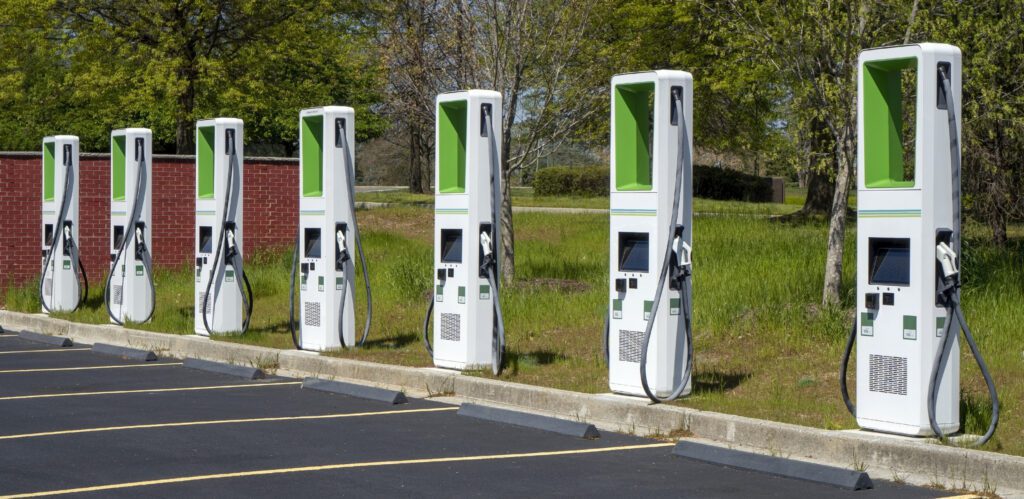
A CFS policy is a unique way to establish a stable, long-term revenue source that can supplement current EV policies and programs, such as EV purchase and charging station incentives. Most state and local funding sources for EV programs are often quickly exhausted, leading to inconsistent, start-and-stop implementation. A CFS solves this dilemma by creating a self-sustaining system in which cleaner fuels, particularly electricity, are financially rewarded, accelerating the shift away from fossil fuels without relying on limited public funding. CFS policies primarily support two components of transportation electrification:
Charging Infrastructure Deployment
One of the strongest features of a CFS is that credit revenue can be reinvested into EV infrastructure. Entities that generate credits, such as utilities, charging providers, or fleet operators, can use this revenue to build or expand charging stations, upgrade grid capacity, or reduce the cost of EV ownership. Because this funding comes from the credit market itself, rather than state appropriations or utility ratepayer funds, it enables infrastructure growth that is fiscally independent and scalable. In practice, this means more public charging stations, better access for drivers, and faster EV adoption across all sectors.
Medium- and Heavy-Duty Fleet Electrification
MHD vehicles, such as delivery trucks, transit buses, and freight haulers, are both major contributors to transportation emissions andprime candidates for electrification under a CFS. These vehicles consume large amounts of energy, enabling them to generate a significant number of clean fuel credits when electrified. CFS programs can also provide rebates or incentives for purchasing Class 7 and 8 electric trucks, helping fleets overcome the high upfront cost of new equipment. Additionally, fleet operators that install their own charging infrastructure can earn capacity and energy-use credits, turning charging operations into a new revenue stream. The dual benefits of lower operating cost and new revenue potential make MHD electrification far more attractive and financially sustainable.
What this means in practice:
- California has used LCFS credit revenue to deploy thousands of charging ports and support electric truck and bus adoption; it has provided over $1 billion in credit revenue to date for electric vehicle charging, not including residential charging.
- Oregon and Washington are leveraging revenues to expand charging infrastructure and reduce operating costs for commercial and transit fleets. Oregon utility Portland General Electric reported that its residential, multi-family, and DC fast-charging credits generated $5.4 million in 2024 alone. Between 2023 and 2025, Washington’s CFS generated 5.42 million credits, which, at an average price of $65.77/credit over the program’s lifetime, would equate to more than $356 million in revenue; electricity credits were approximately one-third of the total.
How Are Credits Generated?
The more a state electrifies, the more credits it generates; the more credits it generates, the more funding becomes available to electrify further. With a CFS policy, there are three ways to generate credits, depending on whether the EV charging station is used for residential charging or for public, fleet, and/or workplace charging.
Base credits are the foundational level of credit generation under a CFS. They are earned simply by charging an EV, whether at home or at a commercial site. The number of credits depends on the CI of the electricity used, measured either as the average for the entire state or the specific utility’s energy mix in the region.
For example, even if you charge your EV using your local utility’s standard power mix, you still earn base credits because the electricity you use displaces higher-emission gasoline or diesel fuel. These credits recognize the benefit of switching from combustion engines to electric power, regardless of the exact energy source.
Incremental credits go a step further. They are awarded when the electricity used for EV charging comes from sources cleaner than the average grid mix, such as solar, wind, or other renewable energy sources. The cleaner the electricity used for charging, the more credits are earned.
For instance, a company that powers its EV fleet with on-site solar panels would receive additional incremental credits because the electricity used for charging produces fewer lifecycle emissions than the typical utility-supplied mix. These credits help incentivize the adoption of renewable energy and encourage businesses and consumers to pair EV charging with low-carbon electricity generation.
The third type, capacity credits, rewards investment in high-capacity charging infrastructure, such as DC fast chargers or depot charging stations for heavy-duty fleet vehicles. These credits are based on the installed charging capacity and the amount of electricity delivered to EVs over time. Even before chargers are heavily used, infrastructure owners can earn credits simply by making high-power charging capacity available—supporting early investment in the infrastructure needed to scale up electrified transportation. charging capacity available—supporting early investment in the infrastructure needed to scale up electrified transportation.
For example, a fleet depot equipped with multiple fast chargers for trucks can earn capacity credits just for building and maintaining that infrastructure, even if utilization is initially low.
State Policy Design Considerations
As states look to implement a CFS policy, there are several factors that should be considered:
- Consider lessons learned: Policymakers should consider taking the lessons learned from existing CFS policies in California, Oregon, and British Columbia, as these programs have existed for over a decade and have been optimized to account for market changes.
- Include electricity as a fuel option to encourage EV adoption: The inclusion of electricity as a fuel option can provide credits back to the EV sector. This can accelerate EV adoption across the light- medium-, and heavy-duty sectors, including fleets. Policymakers should consider what additional policies are needed to support the EV industry.
- Include a broad coalition in the design process: To ensure the policy is well-designed for the specific context it is being implemented in and to avoid post facto changes, Coalition partners should include transit groups, equity groups, utilities, NGOs, consumer groups, EV charging station operators, and automakers.
- Establish rebates and incentives available to: Low-income customers, electric school buses, transit buses, and other projects related to high priorities for communities.
- Allow for flexibility within credit design: Policymakers should allow for flexibility in determining how to distribute the credits generated from EV charging stations. Potential credit recipients may include EV consumers/fleet operators, OEMs, utilities, EVSE companies, and site hosts. A portion of credits could also be set aside to support equitable transportation electrification (e.g., funding for municipal and rural co-op utility programs, dealer programs, e-truck programs, used EV rebates, and more). Overall, credit distribution should primarily incentivize behaviors that grow the EV market.
- Follow the science: Policymakers must consider the best available science regarding the various fuel types. Greenhouse gas scores should be assigned based on the GREET model’s robust analysis, as used by California and Oregon.
- Consider a regional approach: While recognizing state autonomy, states should also consider collaborating on a regional CFS approach. As a market-based mechanism, a CFS policy can have a greater impact and achieve even more policy objectives when applied across a larger region. States should seek to make their CFS policies interoperable with the CFS markets in other states, both inside and outside the area.
- Set strong, long-term carbon intensity targets: To send a long-term signal to stakeholders and create market certainty, long-term and bold carbon intensity targets should be set.
- Incorporate medium- and heavy-duty vehicle electrification: Medium- and heavy-duty EVs must also be considered in a CFS; this important market segment operates under unique conditions, and policy should be written accordingly.